Peggy and Pam met when we were both hired within a year of each other to teach in the psychology department at Central College in Pella, Iowa. Pam’s background is in cognitive psychology and Peggy’s is in developmental psychology. Each of us settled in Des Moines. It was during our daily commute to Pella that we discovered our common interest in assessment and developed our commitment to integrating service-learning into our courses. From observing our students’ and reading their journals, we thought service-learning was improving their learning. To be certain, however, we knew we needed to find ways to measure specific outcomes of this potentially powerful pedagogy. Subsequently we developed the Problem-Solving Analysis Protocol (P-SAP) and the Cognitive Learning Scale (CLS). Thus began our collaborative work on cognitive outcomes assessment. We invite you to explore our website to learn about these instruments and contact us with any questions. They can be used free of charge for purposes of research and assessment. Peggy and Pam look forward to continuing their collaborative research and scholarship.

Dr. Peggy Fitch is currently Professor Emerita of Psychology at Central College.
Peggy earned her undergraduate degree in psychology from Stephens College in Columbia, Missouri, her master’s in counseling and student personnel administration from University of Maryland, College Park, and her doctorate in developmental and child psychology from the University of Kansas.
While at Central she earned tenure, served as department chair and director of the first-year experience program, and taught in the college’s study abroad program in Merida, Mexico. After twenty years of teaching she was asked by the president to serve as Vice President for Student Development, Title IX Coordinator and Equity Officer.
Peggy retired to expand her engagement as a volunteer advocate with RESULTS, an international grassroots organization working to bring an end to poverty. She also joined the racial justice team of Iowa Citizens for Community Improvement (Iowa CCI) and became more active in Women’s International League for Peace and Freedom (WILPF).
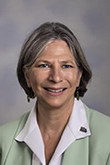
Dr. Pamela Steinke currently serves as Provost and Senior Vice Chancellor for Academic Affairs at University of South Carolina, Upstate.
Pam earned her undergraduate degree in psychology and political science from the University of Michigan. She earned her master’s degree and her doctorate in psychology from the University of California, Davis.
While she was a faculty member in psychology at Central College, she earned tenure, served as department chair, chaired the assessment committee, directed an experiential learning program, and developed her scholarship on cognitive outcomes of service-learning.
Pam served in faculty and administrative roles at North Carolina State University and Meredith College. Her most recent role prior to joining USC Upstate was dean of teaching and learning outcomes at University of St. Francis in Joliet, Ill.
Pam has extensive experience in accreditation, assessment, and high-impact practices. She has published and presented on assessment and service-learning; has been involved in the development of the AAC&U problem-solving rubric; has developed the Problem-Solving Analysis Protocol (P-SAP) with a colleague; and has been a reviewer for Research and Practice in Assessment and the Michigan Journal of Community Service Learning.
She has also led institutions through the accreditation process, writing major sections of successful peer-reviewed reaccreditation reports, has served as a peer reviewer for both Higher Learning Commission (HLC) and SACSCOC, and has presented at both HLC and SACSCOC annual conferences.
Additional Relevant Author Publications:
Fitch, P., & Steinke, P. (April, 2013). Tools for assessing cognitive outcomes of experiential learning. Workshop presented at the NCA HLC Annual Conference on Quality in Higher Education, Chicago.
Fitch, P, Steinke, P, & Hudson, T. (2013). Research and theoretical perspectives on cognitive outcomes of service learning. In P. H. Clayton, R.G. Bringle, & J.A. Hatcher (Eds.), Research on service learning: Conceptual frameworks and assessment, Vol. 2A: Students and faculty (pp. 57-83). Sterling, VA: Stylus.
Steinke, P. & Fitch, P. (2014). Using goal-based learning to understand why service-learning improves cognitive outcomes, Currents in Teaching and Learning, 7(1). For a link to the archives portion of the website where you can access the issue, go to: http://www.worcester.edu/Currents-Archives/
Steinke, P. & Fitch, P. (2011). Outcomes assessment from the perspective of psychological science: The TAIM Approach. In J. Penn (Vol. Ed.), New directions for institutional research: Measuring complex general education student learning outcomes, 149, 15-26. San Francisco: Jossey-Bass.
Steinke, P., & Fitch, P. (2007). Assessing service-learning. Research & Practice in Assessment, 1(2), 1–8. Retrieved from
http://www.rpajournal.com/dev/wp-content/uploads/2012/05/A32.pdf.
Steinke, P., Fitch, P., Johnson, C., & Waldstein, F. (2002). An interdisciplinary study of service-learning predictors and outcomes among college students. In S. H. Billing & A. Furco (Eds.), Advances in service-learning research, Vol 2: Service-learning research through a multidisciplinary lens, (pp.73-102). Greenwich, CT: Information Age.
Steinke, P. & Harrington, A. (2002). Implementing service-learning in the natural sciences. [Electronic version] National Society for Experiential Education Quarterly, 27 (3), 4-10.